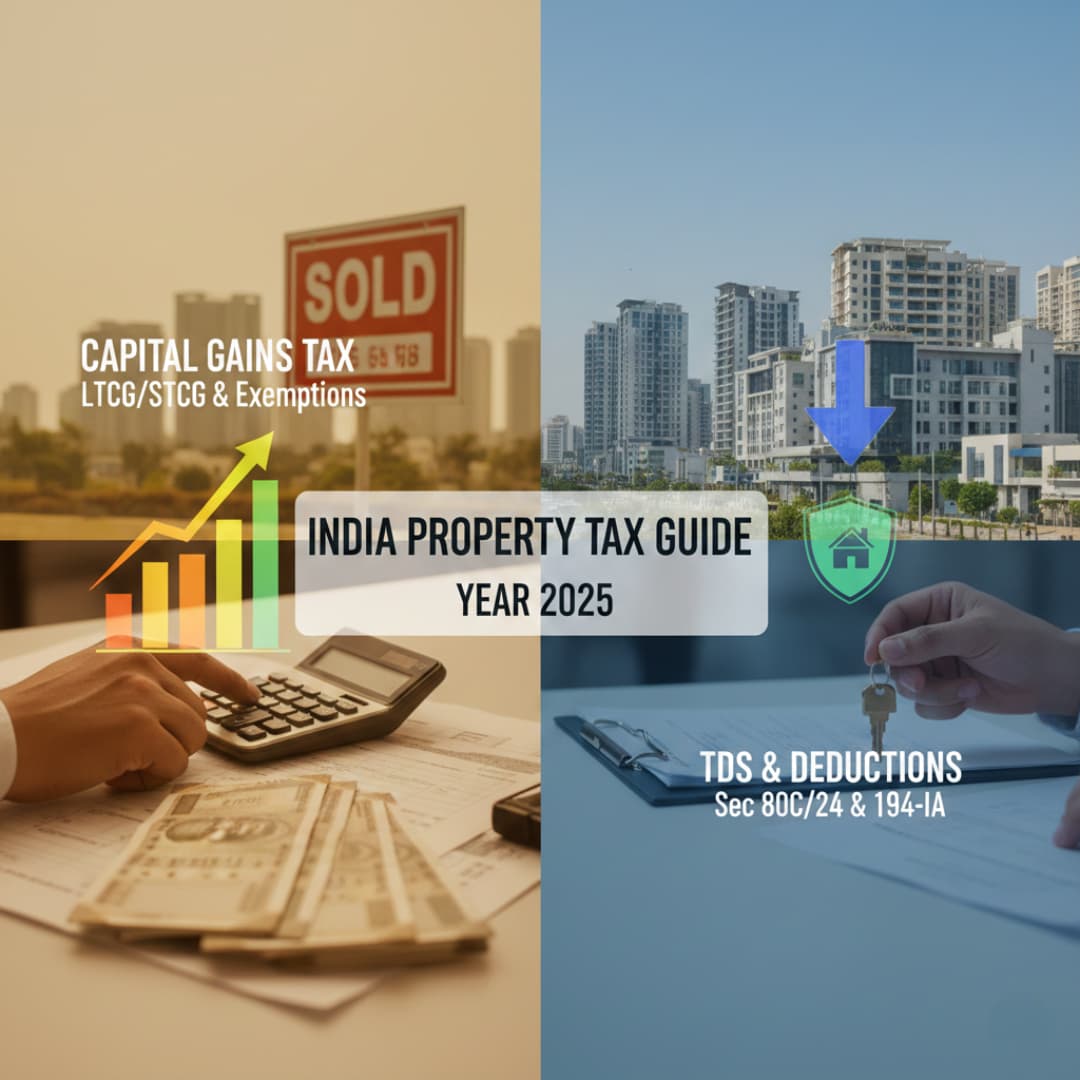
India Property Tax Guide 2025: Capital Gains & TDS for Sellers/Buyers
The purchase or sale of immovable property is one of the most significant financial transactions an individual or Hindu Undivided Family (HUF) undertakes in India. Understanding the tax implications is crucial for effective financial planning and compliance.
This guide is bifurcated into tax impacts for the Seller (primarily Capital Gains Tax) and the Buyer (primarily TDS and deductions).
Table of Contents
I. Tax Impact for the Seller: Capital Gains Tax
Any profit or gain arising from the transfer of a capital asset, such as a house or plot of land, is chargeable to tax under the head Capital Gains.
A. Classification of Capital Gain (Holding Period)
The tax treatment depends on how long the property was held:
| Classification | Holding Period | Tax Treatment |
| Short-Term Capital Asset (STCA) | Held for 24 months or less | STCG (Short-Term Capital Gain) |
| Long-Term Capital Asset (LTCA) | Held for more than 24 months | LTCG (Long-Term Capital Gain) |
B. Tax Rates for Capital Gains
| Type of Gain | Tax Rate | Benefit/Treatment |
| STCG | Taxed at the individual’s normal income tax slab rate (Up to 30% + Surcharge + Cess). | No indexation benefit. |
| LTCG (General Rule) | Taxed at a flat rate of 20% (+ Surcharge + Cess). | Indexation Benefit is available. |
| LTCG (New Regime – Post-July 23, 2024) | Taxed at a flat rate of 12.5% (+ Surcharge + Cess). | No Indexation Benefit. This option is generally for properties acquired on or after July 23, 2024, or an optional choice for assets acquired before this date. |
Indexation Benefit: This benefit adjusts the original cost of acquisition for inflation using the Cost Inflation Index (CII) notified by the Income Tax Department. This significantly reduces the taxable gain, leading to a lower tax liability.
C. Calculating Capital Gain
- Short-Term Capital Gain (STCG): STCG=Full Value of Consideration−Expenditure on Transfer−Cost of Acquisition−Cost of Improvement
- Long-Term Capital Gain (LTCG): LTCG=Full Value of Consideration−Expenditure on Transfer−Indexed Cost of Acquisition−Indexed Cost of Improvement
D. Saving Long-Term Capital Gains Tax (LTCG Exemptions)
A seller can claim exemption from LTCG by reinvesting the gain or sale proceeds, primarily under the following sections:
| Section | Condition for Exemption | Investment Requirement | Exemption Limit |
| Section 54 | Sale of a Residential House Property. | Reinvest capital gain into one new residential house in India. | Max exemption ₹10 Crores. One-time option to invest in two residential houses if the LTCG does not exceed ₹2 Crores. |
| Section 54F | Sale of any long-term asset other than a residential house (e.g., land, commercial property, shares, gold). | Reinvest Net Sale Consideration (not just the gain) into one new residential house in India. | Max exemption ₹10 Crores. |
| Section 54EC | Sale of any long-term asset (including a residential house). | Reinvest capital gain in specified bonds (e.g., NHAI/REC/PFC/IRFC) within 6 months of sale. | Maximum investment capped at ₹50 Lakh per financial year. |
Key Timelines for Reinvestment:
- Purchase: 1 year before or 2 years after the date of sale.
- Construction: Within 3 years after the date of sale.
Capital Gains Account Scheme (CGAS): If the seller cannot invest the capital gain/sale proceeds before the Income Tax Return (ITR) due date (usually July 31st), the uninvested amount must be deposited in a CGAS account with a bank. The amount so deposited will be treated as investment for the exemption, provided it is utilized within the prescribed time limit.
II. Tax Impact for the Buyer
The buyer’s tax liabilities and benefits are focused on TDS, stamp duty, and the home loan.
A. Tax Deduction at Source (TDS) – Section 194-IA
The buyer has a statutory obligation to deduct and deposit Tax Deducted at Source (TDS) on the payment made to a resident seller.
- Applicability: TDS is mandatory if the sale consideration or the Stamp Duty Value (whichever is higher) of the immovable property is ₹50 Lakhs or more.
- TDS Rate: 1% of the sale consideration or the Stamp Duty Value, whichever is higher.
- Compliance:
- The buyer must deduct the TDS at the time of payment to the seller (including instalments).
- The buyer must deposit the TDS using Form 26QB within 30 days from the end of the month in which the deduction was made.
- The buyer is required to issue a TDS certificate (Form 16B) to the seller, which can be downloaded from the TRACES portal.
Crucial Note: Failure to deduct or deposit TDS attracts penalties and interest on the buyer. The buyer does not need a TAN (Tax Deduction Account Number) for this.
B. Tax Deductions on Purchase Expenses (Homebuyer Benefits)
A buyer can claim deductions on certain property-related expenses and loan repayments.
| Section | Deduction Type | Maximum Limit | Conditions |
| Section 80C | Principal Repayment of a housing loan. | ₹1.5 Lakh (Overall Limit). | Available only if the house is completed and possession is taken. Lock-in of 5 years. |
| Section 80C | Stamp Duty & Registration Charges paid. | ₹1.5 Lakh (Overall Limit). | Claimable only in the financial year in which the payment is made. Available only for a Residential House. |
| Section 24(b) | Interest on a housing loan for a self-occupied property. | ₹2 Lakh (Separate Limit). | Available from the financial year in which the property is completed and possession is taken. |
| Section 80EEA | Additional Interest on a housing loan. | ₹1.5 Lakh (Separate Limit). | Applicable only for first-time homebuyers who meet the eligibility criteria (Stamp Duty Value up to ₹45 Lakh, loan sanctioned between 01.04.2019 and 31.03.2022). |
New Tax Regime (FY 2025-26): Tax deductions under Section 80C, 80EEA, and others are not available if the taxpayer opts for the simplified lower-rate New Tax Regime, except for the deduction for interest under Section 24(b) for a Let-Out property. For a Self-Occupied property, the benefit under Section 24(b) is not available in the New Regime.
C. Stamp Duty Value (SDV) vs. Sale Consideration
To curb the use of black money, the Income Tax Act provides an anti-abuse provision:
- If the Sale Consideration is less than 110% of the Stamp Duty Value (SDV) (also known as Circle Rate or Ready Reckoner Rate), the SDV will be considered the Full Value of Consideration for calculating the seller’s capital gains.
- The seller’s liability could increase significantly if the sale price is too low compared to the government’s SDV.
III. Summary Checklist for Compliance
| Party | Compliance/Action | Tax Implication |
| Seller | Calculate Capital Gain (STCG/LTCG). | Must report in ITR. Pay tax at slab/20%/12.5%. |
| Seller | Reinvest capital gains/sale proceeds. | Claim exemption under Sec 54, 54F, or 54EC. |
| Seller | Receive Form 16B from the buyer. | Utilize this as proof of TDS paid, claim it as a credit in ITR. |
| Buyer | Deduct TDS (1%) if value ≥₹50Lakhs. | Mandatory under Sec 194-IA. |
| Buyer | Deposit TDS using Form 26QB. | Must be done within 30 days of month-end. |
| Buyer | Claim Sec 80C/24(b) deductions. | Reduces taxable income for home loan principal/interest and stamp duty (if opting for the Old Regime). |
Disclaimer: The tax laws are subject to annual changes by the Finance Act. This article is based on the laws prevalent for the Assessment Year 2025-26 and is for informational purposes only. You must consult a qualified Chartered Accountant for advice specific to your transaction.